
Farm Bill Compliant THCA: What It Means, Why It Matters, and Where Things Stand Today
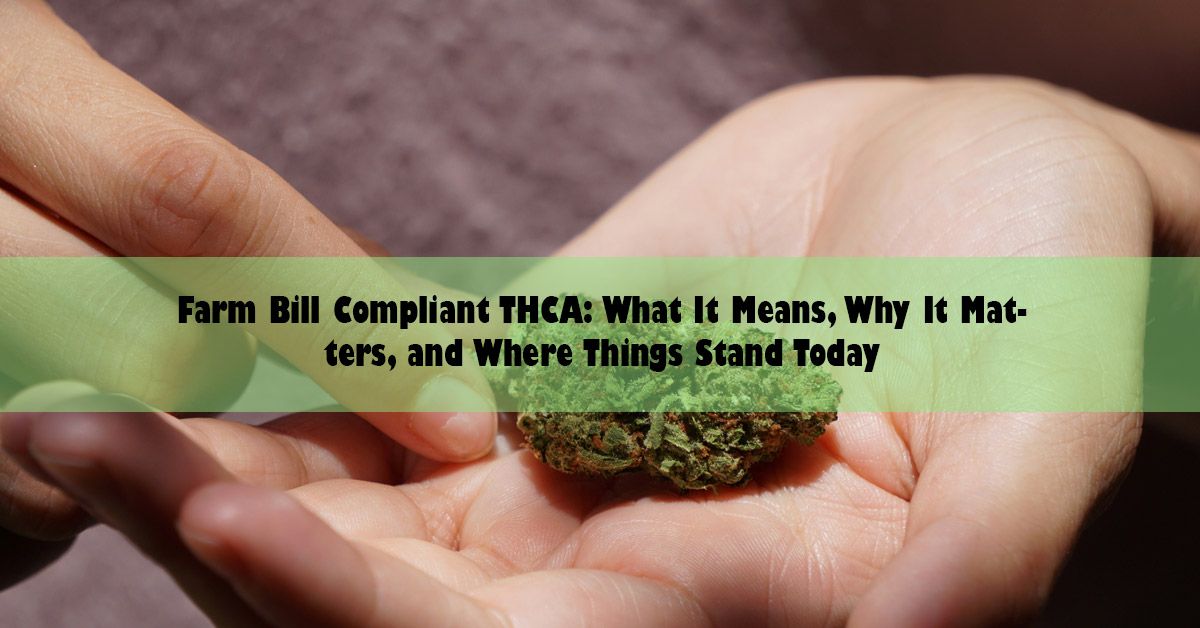
If you've been shopping for hemp products lately, you've probably seen the phrase "farm bill compliant THCA" on labels and product pages. It sounds reassuring. Official, even. But what does it actually mean and is compliance as simple as slapping a label on a package?
The answer is more layered than most brands will admit. Here's an honest, grounded breakdown.
What Is THCA, Exactly?
THCA stands for tetrahydrocannabinolic acid. It is the raw, natural form of THC that exists in the hemp plant before heat is applied. In its unheated state, THCA is non-intoxicating. Your body cannot get high from it directly because it does not bind to the brain's CB1 receptors the same way THC does.
The chemistry is straightforward. THCA contains an extra carboxyl group (COOH) in its molecular structure. When you apply heat through smoking, vaping, or cooking that carboxyl group breaks off in a process called decarboxylation. What remains is Delta-9 THC, the active compound most people associate with cannabis's psychoactive effects.
Think of THCA as a locked version of THC. Raw and harmless until the key heat turns it.
This distinction matters enormously for legal purposes, and it is precisely what created the so-called "THCA loophole" under the 2018 Farm Bill.
The 2018 Farm Bill and the THCA Question
The Agriculture Improvement Act of 2018 - better known as the 2018 Farm Bill - removed hemp from the Controlled Substances Act. It defined hemp as Cannabis sativa L. containing no more than 0.3% Delta-9 THC on a dry weight basis.
Notice what that definition did not mention: THCA.
Because the law measured only Delta-9 THC at the point of testing - and THCA in its raw form is technically not Delta-9 THC - hemp flower with high THCA content could pass federal testing and still be sold legally. A flower tested at 25% THCA but under 0.3% Delta-9 THC was, by definition, hemp under that law.
This created a growing market for farm bill compliant THCA products - particularly flower, pre-rolls, and concentrates - that functioned nearly identically to traditional cannabis products once heat was applied, yet sat in a federally legal gray zone.
Critics called it a loophole. Advocates called it an unintended legislative gap. The industry called it an opportunity.
What "Farm Bill Compliant THCA" Actually Means
When a brand labels a THCA product as "farm bill compliant," it typically means the product was sourced from hemp that tested at or below 0.3% Delta-9 THC on a dry weight basis - meeting the 2018 Farm Bill's definition of legal hemp.
To be genuinely compliant, a product should also carry:
- A Certificate of Analysis (COA) from an accredited, third-party lab
- Transparent cannabinoid testing results showing Delta-9 THC levels
- Proof of hemp sourcing from a licensed cultivator
- Proper labeling with no misleading claims
Third-party lab testing is not optional - it is the backbone of credibility. Any brand making compliance claims without publicly available COAs is asking you to take their word for it. That's not compliance; that's marketing.
The Legal Landscape Is Shifting — Fast
Here is where things get complicated, and where you need current information rather than outdated reassurances.
On November 12, 2025, President Trump signed into law the Continuing Appropriations Act, 2026 (Public Law No. 119-37). Section 781 of Division B of that act significantly rewrites the federal definition of hemp. The changes take effect November 12, 2026 — one year after signing.
Under the new law, "hemp" will be defined using a total THC standard, not just Delta-9 THC. The formula counts THCA in the calculation. Hemp must have a total THC concentration — inclusive of THCA and Delta-8 THC — of no more than 0.3% on a dry weight basis. Additionally, finished hemp-derived cannabinoid products will be capped at 0.4 milligrams of total THC per container.
This is a seismic shift. A hemp flower testing at 25% THCA would be wildly out of compliance under this standard - even if its Delta-9 THC content is near zero. As legal analysts at Perkins Coie noted in November 2025, these changes represent "the most significant federal developments on hemp since the 2018 Farm Bill."
In plain terms: most THCA flower products currently on the market would become federally unlawful under the new definition once it takes effect in November 2026.
What the Industry Is Doing About It
Congress has not been quiet on this issue. Several legislative responses are already in motion.
The Hemp Planting Predictability Act (H.R. 7024), introduced in January 2026 by Representative Baird with bipartisan co-sponsors, would delay the Section 781 implementation by three years - pushing the effective date to November 2028. A Senate companion bill was introduced by Senators Klobuchar, Paul, and Merkley.
Meanwhile, the Cannabinoid Safety and Regulation Act (CSRA), introduced in December 2025 by Senators Wyden and Merkley, proposes a full regulatory framework - including THC limits of 5 mg per serving for edibles, a federal minimum purchase age of 21, mandatory third-party testing, and standardized labeling requirements.
And in February 2026, House Agriculture Committee Chairman Glenn Thompson filed an 802-page draft of the Farm, Food, and National Security Act of 2026, signaling that a comprehensive reauthorization is actively in progress.
None of these proposals have been enacted yet. The law signed in November 2025 remains the most current federal framework. Whether it gets delayed, replaced, or takes effect as written - that remains an open question.
State Laws Add Another Layer
If federal law feels complicated, state law adds another dimension entirely. Several states have already moved to restrict or ban THCA products ahead of any federal change.
Tennessee passed HB 1376, banning products containing THCA and synthetic cannabinoids. Louisiana enacted HB 952 in 2025, banning smokable hemp including THCA flower at retail. Florida already applies a total THC standard under state statute, making high-THCA flower effectively prohibited for inhalation. Georgia, Mississippi, North Dakota, and Rhode Island have each implemented their own restrictions.
At the same time, a Texas bill (SB3) that would have eliminated that state's $8 billion hemp industry was vetoed by Governor Greg Abbott - showing that political outcomes on this issue can genuinely go either way.
The bottom line: "farm bill compliant" is a federal designation. It does not guarantee legality in your state. Always verify your state's specific rules before purchasing or selling THCA products.
How to Identify a Genuinely Compliant THCA Product
Not every product claiming compliance actually delivers it. Here is what to look for when evaluating a farm bill compliant THCA product:
Third-party COA with full cannabinoid panel. The certificate should come from an ISO-accredited laboratory, not a lab the brand owns or funds. It should show Delta-9 THC at or below 0.3% dry weight.
Hemp source documentation. The cultivator should be licensed under state or federal hemp programs. Ask for it. Transparent brands provide this without being pushed.
Honest labeling. Products should not make unsupported medical claims. They should clearly disclose the presence of THCA and provide usage guidance.
Manufacturing standards. Look for cGMP (Current Good Manufacturing Practice) certification. It signals that a brand is operating at a higher standard than the minimum required.
No synthetic cannabinoids. Some products blend THCA with synthetic compounds. These carry their own legal risks and are a different category of concern entirely.
The Bottom Line
Farm bill compliant THCA is a real legal category - one built on the 2018 Farm Bill's Delta-9 THC threshold and supported by years of industry and legal development. For now, products derived from hemp containing less than 0.3% Delta-9 THC remain federally legal under that framework.
But "for now" is doing a lot of work in that sentence.
The November 2026 deadline is real. Federal law is actively shifting. State-level restrictions are growing. And the industry is fighting hard for regulatory clarity - with proposals ranging from outright repeal to full regulatory frameworks already on the table.
If you are a consumer, buy from brands that invest in genuine transparency: third-party testing, clear sourcing, honest communication about what THCA is and what it does.
If you are a retailer or brand, the time to get your compliance posture in order is now - not November 2026.
The hemp industry has always rewarded the people who read the fine print. This is one of those moments.
About the Author
Erin Zadoorian is the co-founder of Exhale Wellness, where he focuses on building high-quality hemp and cannabinoid products for modern consumers. His work centers around product innovation, transparency, and educating customers about CBD and THC alternatives, helping people make more confident and informed choices in the cannabis space.